Discover the best AI customer service chatbots for 2026. Compare autonomous execution, visual guidance and advanced capabilities for software companies.
The AI customer service chatbots market continues experiencing unprecedented growth, with 80% of customer service organizations implementing generative AI by 2026. Modern AI agents handle customer inquiries autonomously through natural conversation, execute tasks across multiple channels, and resolve issues without human intervention. The next evolution adds visual capabilities: platforms that can understand your product interface and provide on-screen guidance when text-based explanations aren't enough, transforming both the speed and quality of customer support.
Best AI Chatbots for Customer Service
Our evaluation prioritized platforms with G2 ratings of 4.4 or higher, proven enterprise adoption, innovative AI capabilities, and documented ROI evidence. These criteria ensure recommendations based on real-world performance rather than marketing promises, focusing on solutions that deliver measurable business impact through reduced resolution times, improved customer satisfaction, and operational cost savings.
Our Top Picks at a Glance
- Fullview - Complete AI agent platform handling autonomous conversations across chat and email, plus unique screen-aware visual guidance (4.8/5 on G2)
- Ada - Conversation automation platform with multilingual support and professional services (4.6/5 on G2)
- Drift - Revenue-focused conversational marketing and sales automation (4.4/5 on G2)
- Intercom Fin - GPT-4 powered AI agent resolving up to 65% of conversations autonomously (4.5/5 on G2)
- LivePerson - Enterprise conversational AI with voice and messaging at scale (4.1/5 on G2)
- Salesforce Einstein - CRM-native AI with deep customer data integration (4.3/5 on G2)
- Zendesk AI - Native ticketing integration with intelligent triage and agent productivity tools (4.3/5 on G2)
Why These Tools Made the List
Macro trends driving AI adoption include 24/7 customer service expectations, mounting cost pressure on support teams, and generative AI breakthroughs that enable natural language understanding at scale. Gartner predicts that 80% of customer service and support organizations will integrate generative AI technologies to enhance customer experiences by 2026, while agentic AI will autonomously resolve 80% of common customer service issues without human intervention by 2029.
Key adoption statistics demonstrate market maturity:
- 95% of customer interactions expected to be AI-powered by 2026
- 78% of organizations already use AI in at least one business function
- 45% of support teams actively using AI in customer service operations
- 90% of customers rate immediate response as critical, with 60% defining "immediate" as within 10 minutes
Our selection criteria emphasized UI awareness capabilities, large language model sophistication, enterprise security posture, and integration simplicity that enables rapid deployment without extensive technical overhead. The most successful implementations combine conversational intelligence with the ability to understand application interfaces and execute tasks autonomously rather than just providing text-based instructions.
Companies implementing comprehensive AI customer service solutions typically achieve $3.50 in ROI for every $1 invested, with top-performing organizations achieving up to 8x ROI. Industry data shows that conversational AI is projected to save $80 billion in labor costs by 2026, making platform selection increasingly critical for competitive advantage.
Who Each Tool Is Best For
This analysis reveals different approaches to AI customer service, each optimized for specific use cases and organizational contexts.
Chatbots vs AI Support Agents
Modern AI platforms like Fullview, Intercom Fin, and Zendesk AI all provide autonomous conversational agents that handle customer inquiries through natural language, learn from your documentation, and resolve issues without human intervention. The core capabilities (understanding questions, pulling from knowledge bases, executing tasks) are now table stakes.
The differentiation comes in how platforms handle situations where conversation alone isn't enough. Some platforms stop at text-based responses. Others add visual capabilities that transform how customers learn and navigate your product.
What Changes with Visual Guidance
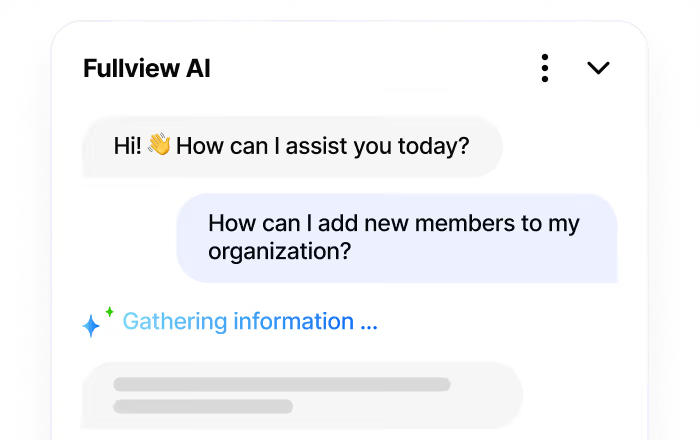
Fullview provides the same autonomous conversational AI as competitors: answering product questions, handling support tickets, and resolving issues through chat and email. Where Fullview differs is adding the ability to see your application interface and provide on-screen visual guidance when text explanations create friction.
Conversational AI foundation (shared across modern platforms): AI agents understand customer intent, search knowledge bases for relevant answers, maintain conversation context, and handle inquiries autonomously across chat and email. Whether you choose Fullview, Intercom Fin, or Zendesk AI, you get sophisticated natural language processing that resolves the majority of standard support questions.
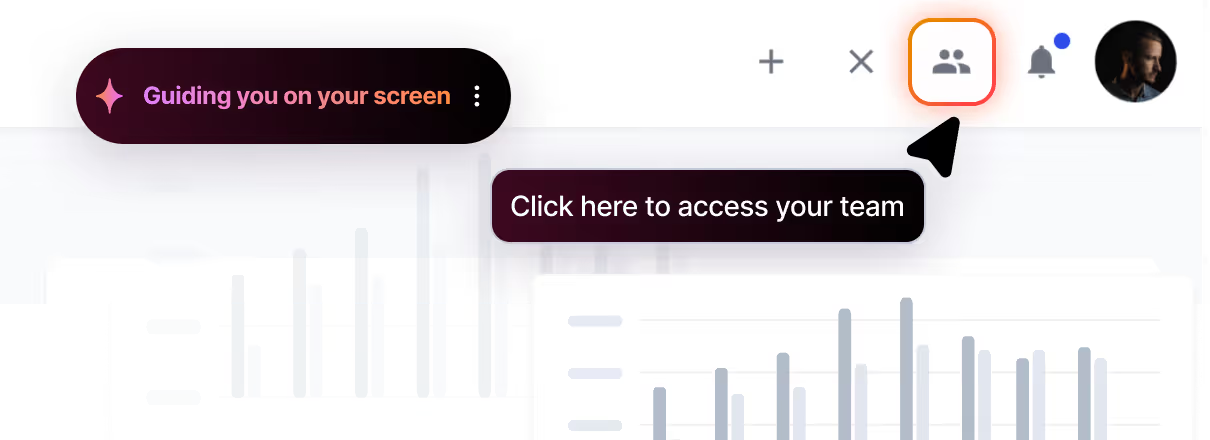
Visual guidance addition: When questions involve product navigation, multi-step processes, or interface-related confusion, Fullview can analyze your application interface in real-time and provide step-by-step visual walkthroughs directly on the customer's screen. This addresses scenarios where "click here, then here, then enter this" text instructions create back-and-forth loops.
Complete platform approach: All interactions (whether resolved through conversation alone or with visual assistance) are automatically recorded with session replays. When AI reaches its limits, conversations escalate to human agents with full context including cobrowsing capabilities for real-time guidance.
The fundamental contrast becomes clear when comparing approaches to the same customer question:
Customer asks: "How do I update my payment method?"
All modern platforms (Fullview, Intercom Fin, Zendesk AI) understand the question and provide accurate text-based instructions: "Go to Settings, then Billing, then Payment Methods. Click Add New Card and enter your information."
Text-only platforms stop there. The customer reads the instructions and tries to follow them, potentially getting lost or confused about which "Settings" menu or where exactly to click.
Fullview adds visual guidance: While providing the same conversational explanation, Fullview can simultaneously navigate to the payment settings, highlight the correct interface elements on the customer's actual screen, and provide step-by-step visual walkthroughs showing exactly where to click, turning potentially confusing text instructions into clear on-screen guidance.
When Different Approaches Fit Best
All modern AI platforms handle the core use case: answering customer questions through intelligent conversation. The decision comes down to your specific support patterns and product complexity.
Platforms with visual guidance (like Fullview) provide the most value for:
- Software applications where customers frequently ask "where do I find..." or "how do I set up..."
- Products with configuration, settings, or multi-step workflows
- Technical products where showing is faster than explaining
- SaaS companies where product questions, onboarding, and feature adoption drive support volume
- Any product generating "I don't see that" or "where is that located" responses
Text-based conversation platforms (like Intercom Fin, Ada, Zendesk AI) excel when:
- Questions are primarily informational ("What's your refund policy?", "When will this ship?")
- Support is mainly transactional (order status, account updates, billing questions)
- The product interface is straightforward enough that text instructions work effectively
- Teams prioritize integration with existing helpdesk ecosystems over visual capabilities
Agent productivity focused platforms (like Zendesk AI, Salesforce Einstein) excel when:
- Organizations prioritize making human agents faster rather than full automation
- Deep integration with existing CRM and ticketing workflows is critical
- Complex escalation and routing requirements need sophisticated management
E-commerce platforms (like Gorgias, Tidio) excel for:
- Shopify, Magento, and WooCommerce stores
- Order tracking, shipping updates, and return processing
- Cart abandonment recovery and product recommendations
Performance comparison data across approaches:
- AI agents achieve 85% customer satisfaction rates across all types
- Support agents with AI tools handle 13.8% more inquiries per hour
- Organizations pairing agents with virtual assistants handle 7.7% more simultaneous chats
- AI implementations in SaaS reduce churn by 10-15% over 18 months
- Platforms adding visual guidance show 82% reduction in resolution times for interface-related questions
- Intercom Fin achieves up to 65% autonomous resolution at companies like Lightspeed Commerce
- Zendesk AI helps agents close 31% more conversations daily when used as a copilot
How Escalation and Guardrails Work
Effective autonomous agents operate within a hybrid model that attempts autonomous resolution first, then seamlessly escalates to human agents with complete session context when needed. This approach maximizes efficiency while ensuring complex issues receive appropriate attention without losing valuable interaction history.
Different platforms handle escalation differently based on their architecture:
Fullview preserves session replays, console logs, and complete interaction context when transferring to human agents, eliminating the frustrating "please repeat your issue" experience. Support teams can review visual recordings of what happened during AI-assisted sessions or jump directly into cobrowsing for real-time guidance.
Intercom Fin automatically transfers conversations to human teammates when confidence drops, passing along the full conversation history and customer context from the Intercom platform. The AI provides a summary of what was attempted and why escalation occurred.
Zendesk AI integrates escalation directly into existing ticket workflows, routing complex cases to specialized agent groups while preserving all AI interaction history and suggested responses for agent review.
Essential guardrail checklist for autonomous agents across platforms:
- Authorization scopes limiting which interface elements and actions agents can access based on user permissions
- Action limits preventing agents from making irreversible changes without explicit user confirmation
- Confidence thresholds requiring 95% certainty before executing complex tasks or sensitive operations (Fullview allows custom threshold configuration)
- Audit trails logging all agent actions for compliance review and continuous improvement
- Escalation triggers automatically engaging human agents when confidence drops below thresholds or when encountering novel scenarios
- Data protection ensuring sensitive information is masked or redacted during both autonomous operation and human handoffs
Which Platform Fits Your Scenario?
Use these real-world scenarios to identify which platform aligns with your specific needs:
Scenario 1: Software product with interface questionsYour customers ask about product features, settings, and navigation (questions like "where do I find...", "how do I set up...", or "I don't see that option") and text explanations lead to back-and-forth clarification.→ Fullview - Handles all standard product questions through conversational AI, plus adds visual guidance for interface-related questions, showing users exactly where to click on their actual screen.
Scenario 2: Already invested in Intercom ecosystemYour team uses Intercom for messaging, and you want AI that integrates seamlessly without changing platforms.→ Intercom Fin - Native integration preserves existing workflows, conversation history, and team familiarity while adding autonomous resolution capabilities achieving up to 65% automation.
Scenario 3: Global support across many languagesYou need to provide automated support in 50+ languages across different regions with text-based conversation handling.→ Ada - Strong multilingual capabilities and conversation automation across languages, though lacks visual guidance for complex in-app workflows.
Scenario 4: Zendesk-first organization prioritizing agent efficiencyYou have 50 support agents already trained on Zendesk, and want AI to make them faster rather than replace them.→ Zendesk AI - Native integration provides intelligent triage, suggested responses, and ticket summarization that help agents close 31% more conversations daily.
Scenario 5: Salesforce ecosystem with deep CRM needsYour support, sales, and success teams all work within Salesforce, and you need AI that leverages existing customer data.→ Salesforce Einstein - Deep CRM integration uses customer history, account data, and existing Flows to provide context-aware support within your established ecosystem.
Scenario 6: E-commerce store on ShopifyYou run a growing Shopify store handling order status, shipping, and return questions.→ Gorgias or Tidio - E-commerce-specific platforms integrate directly with Shopify, providing order tracking, automated refunds, and cart recovery without complex setup.
Scenario 7: B2B sales team needing lead qualificationYour priority is converting website visitors into qualified leads for your sales team.→ Drift - Conversational marketing focus qualifies leads, books meetings, and routes prospects to sales rather than optimizing for post-sale support.
How to Choose an AI Customer Service Chatbot
Connect your specific pain points around support volume, response time SLAs, and operational costs to the selection framework that matches platform capabilities with business requirements.
Match to Your Stack and Channels
Required integrations vary by organization but typically include:
CRM platforms: Salesforce, HubSpot for customer context and relationship management
Ticketing systems: Zendesk, Intercom, Freshdesk for agent workflow and case management
Communication channels: Voice systems, SMS platforms, social media APIs for omnichannel support
Analytics tools: Google Analytics, Mixpanel for user behavior tracking and conversion optimization
Implementation approaches differ significantly:
Native helpdesk AI (Intercom Fin, Zendesk AI) provides seamless integration within existing platforms, preserving team workflows and eliminating the need for new tool adoption. These solutions excel when your team is already invested in a specific helpdesk ecosystem.
Standalone AI platforms (Fullview, Ada) integrate with major helpdesks while adding specialized capabilities like visual guidance or enterprise compliance features. These work best when you need capabilities beyond what native AI provides, such as interface-aware support for complex software products.
CRM-native AI (Salesforce Einstein) leverages existing customer data and workflows within the Salesforce ecosystem, ideal for organizations where support, sales, and success teams all operate in Salesforce.
Most modern platforms offer simple integration through script installation or API connections, with deployment timelines ranging from days to weeks rather than months. The key consideration is whether you need deep integration with a specific platform or flexibility to work across multiple systems.
Evaluate Security and Compliance
Enterprise deployment requires comprehensive security certifications including SOC 2 for operational security controls, HIPAA readiness for healthcare applications, and GDPR compliance for European customer data protection (penalties up to €20M or 4% annual turnover). These certifications provide third-party validation of security practices and enable deployment in regulated industries with strict data protection requirements.
Data masking and PII redaction capabilities become critical when agents access sensitive customer information during support interactions. Best-practice implementations automatically identify and protect social security numbers, payment information, and personal identifiers without manual configuration, maintaining full functionality while ensuring compliance.
Security approaches vary by platform:
- Fullview provides pixel-level data redaction and dynamic masking for real-time protection during screen sharing and visual guidance
- Ada emphasizes enterprise compliance with HIPAA-BAA agreements and configurable data residency for regulated industries
- Intercom Fin uses Intercom's established security infrastructure with SOC 2 Type II and GDPR compliance
- Zendesk AI leverages Zendesk's enterprise security posture with role-based access controls and audit logging
- Salesforce Einstein includes Einstein Trust Layer for data protection within the Salesforce ecosystem
Healthcare organizations report only 56% satisfaction with current privacy protections, indicating significant opportunity for platforms that prioritize comprehensive data security from the ground up rather than adding protection as an afterthought.
Estimate Total Cost and ROI
Calculate total cost of ownership using the formula: (license fees + usage charges + implementation costs) ÷ (tickets automated × cost per ticket resolved) to determine break-even timeline and ongoing ROI potential.
Industry leaders achieve average 8x ROI through comprehensive AI implementation that reduces operational costs while improving customer satisfaction and retention rates. These returns come from direct cost savings through automation, increased customer lifetime value through improved experiences, and operational efficiency gains that enable support teams to focus on high-value activities.
Key cost metrics to consider:
- Self-service channels cost $1.84 per contact vs $13.50 for assisted channels
- AI implementations reduce labor costs by up to 90% for routine customer service tasks
- Each abandoned call costs businesses $2.70-$5.60 per interaction
- 52% of customers abandon companies entirely due to slow response times
- SaaS companies spend 8% of ARR on customer support and success
Fullview offers outcome-based pricing that aligns costs with successful customer resolutions rather than seat counts or usage metrics, providing budget predictability and ensuring ROI measurement tied directly to business value delivered. This approach eliminates the risk of unexpected cost escalation as teams scale or customer interaction volume increases.
Implementation, Security and ROI
Successful deployment requires connecting platform selection decisions to practical rollout considerations that ensure rapid time-to-value and sustainable operational benefits.
Integration Checklist for Faster Time to Value
Follow this systematic approach to minimize implementation timeline while maximizing platform effectiveness:
- Sandbox environment setup with test data and representative user scenarios for safe experimentation
- API key configuration and authentication testing to ensure secure data access and functionality
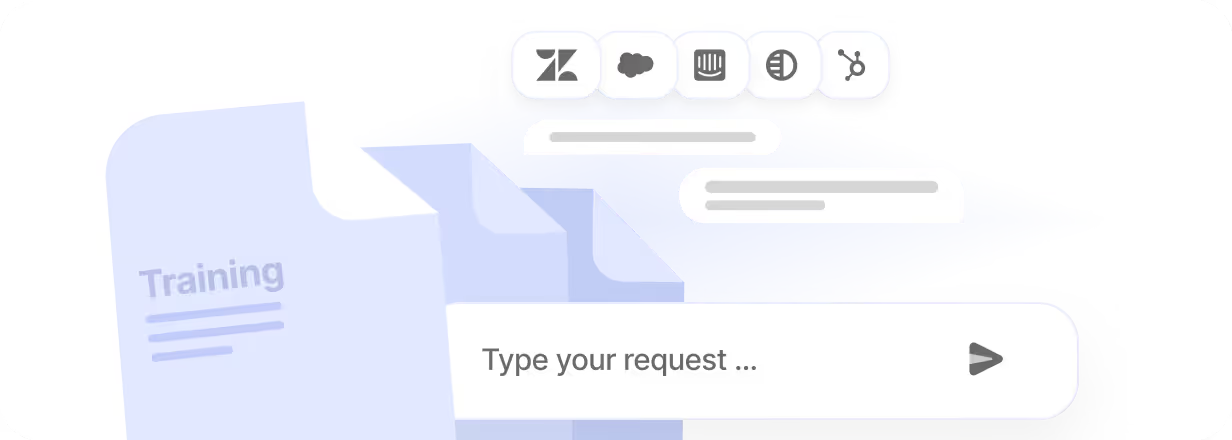
- Knowledge base preparation connecting your documentation, help articles, and internal resources (all platforms require this)
- UI element mapping for platforms requiring interface understanding (automated with visual guidance platforms, manual workflow setup for others)
- Test flow creation covering common support scenarios and edge cases that reveal integration issues
- Go-live monitoring with gradual traffic increase and performance optimization based on real usage patterns
Implementation timelines vary significantly based on platform approach and organizational complexity:
Privacy, Redaction and Data Handling in Regulated Industries
Advanced data protection requires tokenization of sensitive fields, field-level encryption that maintains searchability, and deployment options ranging from cloud-hosted SaaS to on-premises installations for maximum data control. Organizations in healthcare, financial services, and government sectors need platforms that provide comprehensive audit trails and configurable data residency to meet regulatory requirements.
Fullview's dynamic masking technology automatically identifies sensitive information patterns and applies appropriate redaction in real-time without disrupting agent functionality or user experience. Regional data residency options ensure customer information remains within required geographic boundaries while maintaining platform performance and feature availability.
Measure Success Beyond Deflection
Comprehensive ROI measurement requires tracking operational efficiency metrics, customer experience improvements, and business impact indicators that extend beyond simple ticket volume reduction:
Key performance indicators include:
- Time to resolution improvements measuring how quickly issues move from initial contact to complete resolution
- Customer satisfaction (CSAT) score increases reflecting improved support quality and user experience (AI-powered support achieves 85% customer satisfaction rates)
- Net Promoter Score (NPS) lift indicating stronger customer loyalty and advocacy potential
- Conversion rate improvements when support interactions lead to successful onboarding or feature adoption
- Onboarding completion rate increases demonstrating more effective user activation and product adoption
Monthly business reviews should include before-and-after performance charts that quantify improvements across these metrics, providing stakeholders with clear evidence of platform value and ROI achievement. Research indicates that 64% of customers rate 24/7 availability as the most important feature, making continuous operation metrics particularly valuable for demonstrating competitive advantage.
Frequently Asked Questions
Browse these common questions to quickly find answers to specific implementation and capability concerns.
How Do I Keep AI Answers Accurate Without Exposing Sensitive Data?
Modern AI platforms use retrieval-augmented generation (RAG) with vector databases containing redacted embeddings that maintain semantic meaning while protecting sensitive information. Different platforms implement data protection in complementary ways:
Context-aware protection: Platforms like Fullview analyze your application interface to provide context-aware answers based on actual application state without exposing customer details, payment information, or other protected content through pixel-level data redaction.
Knowledge base encryption: Platforms like Intercom Fin and Zendesk AI store encrypted versions of your documentation, automatically filtering sensitive elements during response generation while maintaining answer accuracy.
Field-level masking: Enterprise platforms like Ada and Salesforce Einstein provide granular control over which data fields AI can access, ensuring compliance with industry-specific regulations like HIPAA and PCI-DSS.
The system can reference relevant context while automatically protecting sensitive information through tokenization, encryption, and configurable redaction rules.
What Guardrails and Confidence Thresholds Should We Set Before Allowing Autonomous Actions?
Best practices include:
- 95% confidence threshold as default for task execution, requiring human approval for lower-certainty scenarios
- Action categorization with different thresholds for read-only operations (lower threshold) versus data modification (higher threshold)
- Human approval loops for irreversible actions like account deletions, payment changes, or security modifications
- Time-based restrictions preventing agents from taking action during maintenance windows or high-risk periods
- User consent requirements for actions that significantly change account settings or access permissions
Fullview's confidence scoring system assigns scores to every question and allows you to set custom confidence thresholds, ensuring the AI only attempts to solve issues with your accepted confidence levels.
How Do AI Agents Hand Off to Humans Without Losing Context?
Effective escalation systems transfer complete interaction history to human agents, eliminating the need for customers to repeat information. Different platforms preserve context in different ways:
Session replay platforms (Fullview) provide visual recordings of every interaction, including user activity, console logs, and network data. Support teams can review exactly what happened during AI-assisted sessions or jump directly into cobrowsing for real-time guidance.
Conversation history platforms (Intercom Fin, Zendesk AI) pass along complete chat transcripts, attempted resolutions, and confidence scores to human agents within the existing ticketing system, maintaining continuity without requiring platform switches.
CRM-integrated platforms (Salesforce Einstein) synchronize interaction data with customer records, ensuring agents see AI attempts alongside customer history, previous cases, and account information all in one view.
The critical elements preserved during handoff include:
- Complete conversation history showing what questions were asked
- Attempted solutions and why they failed
- Customer sentiment and frustration indicators
- Relevant knowledge base articles that were referenced
- Technical context like error messages or system states
This comprehensive context transfer enables agents to begin problem-solving immediately rather than asking customers to re-explain their issues.
How Do I Calculate TCO for High-Volume Support Across Channels?
Use the formula: Total Cost = (Platform licenses + Usage fees + Integration costs + Training expenses) compared against (Current support costs × Automation rate × Time period) to determine net savings and payback timeline.
Consider that self-service channels cost $1.84 per contact versus $13.50 for assisted channels, representing an 86% cost reduction. AI implementations reduce labor costs by up to 90% for routine customer service tasks. Most companies see initial benefits within 60-90 days and positive ROI within 8-14 months, with the 8x ROI achieved by leading implementations typically materializing over 12-18 months as systems learn and optimize performance.
Can an AI Agent See My App and Take Action Inside a Logged-In UI Safely?
Different platforms approach in-application access in different ways:
Visual interface platforms like Fullview understand application interfaces in real-time by analyzing your product's interface structure while respecting role-based access controls that limit actions to user permissions. The system maintains user session security by operating within existing authentication frameworks rather than requiring separate administrative access.
API-based platforms like Intercom Fin and Salesforce Einstein execute actions through data connectors and integrations that authenticate using secure tokens, limiting access to explicitly configured endpoints and data sources.
Agent-assisted platforms like Zendesk AI don't directly access user interfaces, instead providing suggestions and automation within the ticketing system itself while human agents handle in-application tasks.
Security considerations across all approaches:
- Role-based access controls limiting actions to user permissions
- Encrypted authentication tokens for API connections
- Configurable action limits preventing unauthorized changes
- Audit trails logging all agent actions for compliance review
- Data redaction for sensitive information (approaches vary by platform)
- GDPR, SOC 2, and HIPAA-compliant data handling
Which Metrics Prove ROI Beyond Ticket Deflection?
Focus on business impact metrics that connect support quality to revenue outcomes and customer lifetime value, providing stakeholders with clear evidence of strategic value rather than just operational cost savings.
Key performance indicators by platform type:
Customer experience metrics:
- CSAT score improvements (target 85%+, achievable across all modern AI platforms)
- Customer effort score reduction showing easier problem resolution
- NPS lift indicating stronger customer loyalty and advocacy potential
Operational efficiency metrics:
- Support agents handling 13.8% more inquiries per hour with AI tools
- 31% increase in daily conversations closed with AI copilot assistance (Zendesk, Intercom)
- Time to resolution improvements (varies by complexity: 82% reduction possible for workflow-related issues with visual guidance, 30-40% for conversational AI)
Business impact metrics:
- Customer churn reduction (10-15% improvement over 18 months with AI implementations)
- First contact resolution rate increases (leading to 67% churn reduction)
- Support-influenced revenue from improved onboarding and feature adoption
- 61% greater revenue growth for companies with comprehensive AI platforms
Financial metrics:
- Cost per interaction reduction (self-service at $1.84 vs assisted at $13.50)
- Support team efficiency enabling revenue growth without proportional headcount increases
- Overall ROI of $3.50 per $1 invested (average), with top performers achieving 8x returns
The most compelling ROI stories combine operational metrics (faster resolution, higher automation) with business metrics (reduced churn, increased expansion revenue) to demonstrate strategic value beyond just cost savings.
Choosing the Right AI Platform for Your Team
The AI customer service landscape in 2026 offers sophisticated conversational agents across all major platforms. Modern AI (whether from Fullview, Intercom Fin, Zendesk AI, or others) handles autonomous conversations, learns from your documentation, and resolves the majority of customer inquiries without human intervention. This foundational capability is now table stakes.
Success depends on matching platform capabilities to your specific support requirements beyond basic conversation:
For teams already invested in major helpdesk platforms, native AI solutions like Intercom Fin, Zendesk AI, and Salesforce Einstein provide seamless integration with existing workflows while adding autonomous capabilities that leverage your current infrastructure.
For software companies where customer questions frequently involve product navigation, interface elements, or multi-step processes (questions like "where is that setting?", "how do I configure this?", or "I don't see that option"), platforms like Fullview combine the same autonomous conversational AI with visual guidance capabilities that show customers directly on their screens rather than requiring text-based explanations.
For global operations requiring extensive multilingual support across 50+ languages, text-based conversation platforms like Ada focus on language coverage and conversation automation at scale.
The common thread across successful implementations: clear ROI measurement, gradual rollout strategies, and maintaining the balance between automation efficiency and human connection that customers value. Companies implementing comprehensive AI customer service solutions achieve average returns of $3.50 for every $1 invested, with top performers seeing up to 8x ROI through reduced operational costs and improved customer lifetime value.



.webp)